

When moving from a new home, renovation is often necessary. As a rule, the drill holes in the old premises have to be filled and the walls painted. The same applies if you want to modernise your home and give it a new coat of paint. Here, too, paint or wallpaper is primarily used first. When painting or wallpapering, you do not need any special skills or abilities. But a little manual dexterity doesn’t hurt.
Repainting in 13 steps
If you want to give your home a facelift “only” with colour, you should follow the steps below.
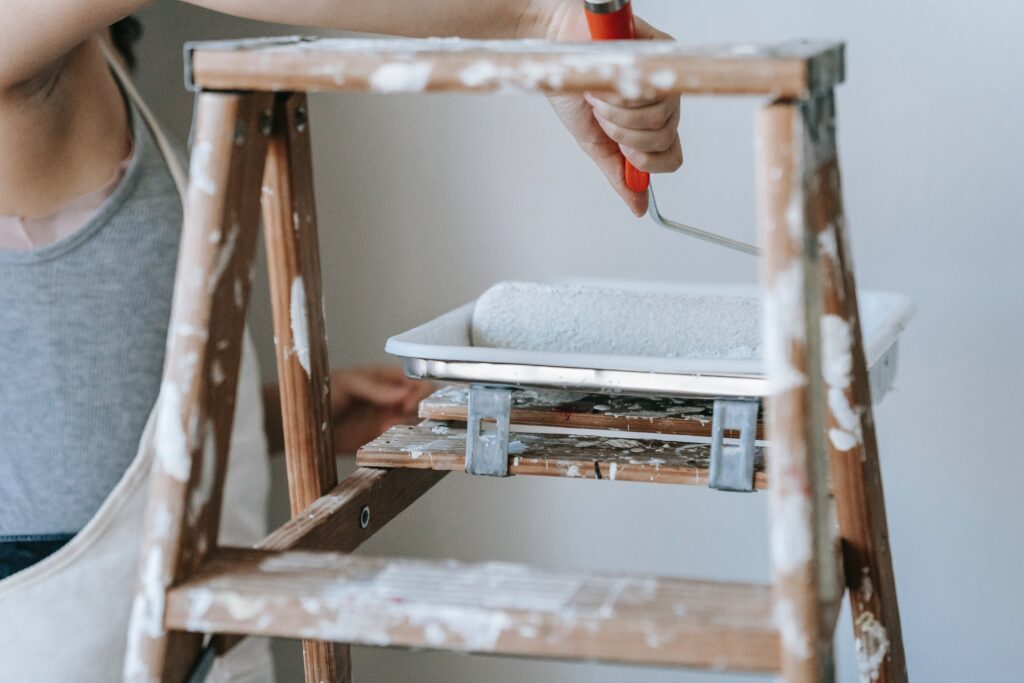
- Get the right equipment: brush, paint roller (paint roller), paint tray, squeegee, telescopic rod, dust sheets and covers, masking tape (adhesive tape), filler, wall filler, paint (emulsion paint, gloss etc)
- Cover floors and furniture
- Mask off edges, corners, door and window frames
- Check walls for holes, cracks, unevenness and, if necessary, touch up with filler
- Mix the paint and pour it into a paint tray
- Apply wall paint with a brush on all edges and corners of the room ceiling
- Rinse the paint roller or paint roller with clear water
- Dip the paint roller in the slightly damp state in the paint tray and then wipe it over a wiping grid
- Apply wall paint to the ceiling with the paint roller and paint in the direction of the incidence of light
- Apply paint again to all edges and corners of the wall to be painted
- Paint the wall surface with the paint roller
- Repeat steps 10 and 11 to paint the rest of the walls
- Remove the masking tape from the masked areas while the wall paint is still damp
Tip: When painting large wall surfaces, we recommend applying the paint crosswise. This means that two or three strips are painted alternately from top to bottom and then the paint is applied across the vertically drawn strips. And this is repeated until the wall is completely coloured. This method ensures an even coat of paint. A new coat of paint can completely change the look and feel a room.
New wallpaper – adding colour and texture
In addition to the variety of colours, there is now an enormous selection of wallpapers. The many patterns and different materials make wallpaper a very popular wall covering again. White walls or colour-coded woodchip wallpaper are increasingly giving way to trendy wallpaper creations such as photo prints, classic stripes or romantic flower patterns. Wallpaper is modern and gives a room a new ambience. By following these steps, wallpapering is no more time-consuming and complicated than painting.
- Get the right equipment: wallpaper, paste, paste brush or paste device, spatula, filler, wallpaper knife or wallpaper scissors, wallpaper brush, wallpaper table, edge trimming rail
- Remove the old wallpaper and repair cracks and bumps
- Close windows and turn off the heating (if on)
- Measure and cut the wallpaper strips, each for one wall
- Mix the paste
- Lay the wallpaper strip with the pattern or colour side on the wallpapering table
- Apply paste to the wallpaper with a brush (brushing from the centre to the ends) and let is soak
- Glue the wallpaper to the wall, from top to bottom, and press onto the wall with a wallpaper brush
- Repeat steps 5, 6 and 7 until the wall is finished with wallpaper
- Cleanly cut the edges of the ceiling and skirting board with the edge trimming rail
Tip: When cutting the strips of wallpaper, make sure that you leave a little space (approx. 3 – 4 cm) at the ends. It is also important that you take the “repeat” (pattern match) into account when cutting sample wallpapers.
While painting and decorating can be hugely rewarding, in our busy lives often we just don’t have all the time we’d like to focus on updating our homes or businesses. It can become a stressful project. Our aim is to provide high quality decorating services at affordable rates, thus saving you time and energy going the DIY route. Get in touch today for a free quote.